Category: Finance

  • A Complete Guide on REIT

    A Complete Guide on REIT

    Every individual looks for expanding his/her investment portfolio. With a variety of investment options available in the market, it often becomes difficult to choose which investment one should opt for.

    There are a lot of financial characteristics to consider before building your investment portfolio. These things include tax rates, liquidity, gains, etc.

    Real estate investing can be a major impetus to your financial portfolio. It can quite literally accelerate your journey to riches if done correctly.

    Most of the time, real estate investing is often associated with owning properties and leasing them out. However, there is more to real estate investing than just this. Real Estate Investment Trusts (REIT) are an important component of real estate investing.

    What is a REIT?

    The full form of REIT is Real Estate Investment Trust.

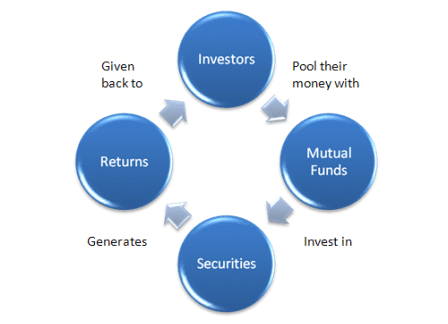
    It is just like a mutual fund. So this brings us to our question, what is a mutual fund?

    Mutual funds essentially make use of pooled money from a variety of investors to buy financial assets like stocks, bonds, etc. Then, the gains from these financial assets are divided proportionately among the mutual fund investors.

    Similarly, REIT pools money from a variety of investors to buy real estate and then generate income. It allows individual investors to earn a portion of that income-producing real estate.

    These real estate portfolios are made with multiple property types. REIT indulges in buying properties and leasing the real estate to other companies/individuals. The income which is generated as a result of leasing out or selling is then distributed proportionately among shareholders.

    Also, REIT is specific to one particular locality of the town/city. Therefore, you must choose the specific location you prefer to invest in.

    Also, REIT is of different types, categorized into many sections including medical REIT, office REIT, residential REIT, retail REIT, etc.

    Healthcare REIT includes nursing homes, medical offices, hospitals, and clinics. Office REIT includes business offices, business districts, etc. Hence, there are a lot of varieties of which REIT available in the market.

    Advantages of REIT

    Everything in life has advantages and disadvantages just like it is said there are two sides to everything: a bright and a dark side.

    Any and every financial decision requires careful analysis before investing. Gauging the pros and cons before going for REIT is very fundamental.

    These are some of the advantages of REITs:

    Diversification

    Diversification is the key mantra underlying investing.

    One of the first things to keep in mind while building an investment portfolio is to diversify it. The old saying, “Don’t put all your eggs in one basket” holds true here.

    Putting all your money into a single investment is never a good idea.

    Rather than investing in one stock or one mutual fund, investing in various assets is a better way to guard against market fluctuations. REITs are very similar to mutual funds in their approach and thus are a good option to add to your investment portfolio.

    Time

    REITs can prove to be very good investment options when invested in for a long period of time. Also, REITs come with a lot of time flexibility.

    Investing for long-term should be your priority if you wish to earn some major gains.

    Liquidity

    While it is easy to believe that selling houses is difficult, it is not entirely true.

    When you invest in a REIT, selling houses and getting back your money is way easier. It is a relatively liquid way of investing in real estate.

    Simple Tax Calculation

    The gains on REIT are charged for taxes just like other incomes. There is no complexity in the calculation of taxes and the whole procedure is really simple.

    Disadvantages of REIT

    While there are a lot of convincing arguments in favor of REIT, there are certain downsides to it as well. Before investing, one should think about the downside as well. Here are some disadvantages or drawbacks:

    Property Taxes

    While property taxes would not affect you directly as an investor in REIT, they would however have an indirect bearing on your gains.

    How?

    Because property taxes can decrease the earnings you get from the REIT.

    Also, property taxes vary from place to place. So you must keep a check on the property rates in the locality you are willing to invest.

    Interest Rates

    Whenever interest rates go up, REIT prices dip. While some people may consider this as an opportunity to sell and earn good money, it is important to keep in mind your long-term investment goals.

    The decision to sell or hold your REIT should be based on your financial goals rather than the market situation.

    Tax

    The gain from REITs is often considered as an ordinary income instead of as a capital gain. Hence, the gains from your REIT are charged at a higher tax rate than capital gains.

    How to proceed with REIT?

    Now that you’ve gauged the advantages and disadvantages of REITs, you can choose whether it’s a good option for you to invest in.

    But how would you approach REIT?

    Research

    Similar to any financial investment, you must do an ample amount of research. Read about which companies are better, which REITs give better returns, and which localities are better to invest in.

    REITs or Mutual Funds that invest in REITs

    You can either invest directly in REITs or choose to invest in mutual funds which then invest in REITs further. The second approach is better for those looking for little effort and greater gains.

    Conclusion

    On the off chance, you are looking to increase your income level and up your investment game, Real Estate Investment Trust is made for you.

    Turbocharge your investments with this simple technique. If you have big-time aspirations for your financial situation, it is time to diversify your portfolio with real estate.

    If you are willing to invest in real estate but wish to avoid its high risk, lack of liquidity, etc., then you must opt for REIT after carefully analyzing its pros and cons.

    I hope this helped!


    By HomeLight Homes

  • Eyal Nachum Talks about Fintech and It’s Future

    Eyal Nachum Talks about Fintech and It’s Future

    The rate of disruption occurring within the financial services business is at an unmatched level, with lots of ‘Fintech’ companies, like Moneta International UAB, moving up the ranks and transforming the way technology improves the practice of moving cash.

    Imagine a globe where the big banks are contending with corporations that have low and nimble footprints, and use everything from new mobile technology to Artificial Intelligence to make the client experience seamless.

    The new backdrop of Fintech groups is picking off parts of the banks and turning them into international businesses that boast a frictionless online experience for the client. Eyal Nachum (co-founder of Moneta International UAB) says, “Banks will not die, but we will see Fintech groups choose off some things like foreign currency transactions.”

    What are ‘Fintech’ groups?

    Fintechs typically provide “better user experience, lower cost and a keen aim on solving a particular problem. They can even build products much quicker and cheaper than big banks as they don’t have the conventional working staff and systems to fund or contend with.

    The financial service sector, which saw the major disruption from Fintech was customer banking. This is possible because customers are looking for new means to transfer their fund on the go and with as little friction as possible.

    The big bank’s infrastructure also allows little space for agility – meaning that Fintechs can range and grow exponentially, providing new products, and services all the time, while the banks are simply applying digital technologies to advance their existing service.

    Fintech has the prospective for a more broad future

    The potential that comes with this ‘decentralization’ of financial services could build an ecosystem where banks and Fintech corporation can work more collaboratively in allocating resources, and therefore making it simpler to keep up in our quickly changing world.

    As people in these new Fintech groups are often not from banking, they are from outside banking environment, thus want to offer a more enhanced experience for the consumer. This creates room for innovation in the broader skills as people come from diverse backgrounds.

    Payment service providers, digital challenger banks, digital wallets, lending platforms, cryptocurrency groups, and data aggregators are all transforming the financial services sector. Blockchain, Artificial Intelligence, and robot technologies are driving improvement in the sector in new ways.

    Superior connectivity will be the key to prolonged existence

    The Fintech segment is fast-moving, and any successful corporation needs to be extremely flexible and highly adjustable to survive. Ensuring that each part of the company is connected, whether it be via data, process, or the people themselves, will help in better decision-making and the capability to stay lively in a time when financial laws and rules can change rapidly.

    Traditional businesses frequently compartmentalize their operations into departments, and in lots of situation, those departments become unsuccessful to communicate, leading to serious oversights. When everything is connected, a good flow of information is possible, meaning Fintech corporation can be much more nimble than their competitors. This can truly pay off when you are contesting against multi-national financial institutions with huge capital and resources.

  • What are the best mutual funds

    What are the best mutual funds

    For the smart options for mutual fund investment now the steps are essential. You need to be specific on this part. For that you need the best deal.

    The ranking with the best funds you find on other sites is a misleading exercise because it doesn’t help you understand how to invest your money but it is a pure vanity metric that often hides many problems. If you are looking for a ranking because you are an advanced investor and you feel you do not need advice, you will hardly find it here.

    Is it worthwhile or not relying on this strategy to invest your money?

    If, on the other hand, you are interested in understanding if it is worthwhile to invest in funds, keep reading because there is so much information useful for you.

    Investing in funds often is not worthwhile

    The mutual fund investment are most of the times a bloodbath to the detriment of the customer organized by the bank and management company, with the aim of putting your hands in your pockets even when the instrument does not makes them incapacitated.

    It will seem a harsh opinion, which among other things contrasts with what your financial promoter will have told you, very interested; thanks to the generous commissions he will put in his pocket, to direct you towards this peculiar investment tool.

    Unlisted actively managed funds : they are the worst because they are not traded on the stock exchange (consequently, they are less liquid for you) and have higher commissions without offering better returns than the market;

    Actively managed listed funds: more transparent and liquid than the former, they often have entry and exit costs and management costs that are too high to justify returns in line with the markets;

    Passive-managed funds or ETFs: these are the ones I prefer because there is no management company that tries to beat the market but the fund simply replicates the reference benchmark. You can learn more about this in the article where I explain how I invest .

    After that, let’s go ahead: below I offer you 5 tips for investing in mutual funds , giving you some tips also and not only to recognize those who, in a frankly bleak landscape, could actually improve the composition of the portfolio.

    Funds almost never perform better than market benchmarks

    When you are buying shares in a mutual fund, you are trying to beat the market, otherwise you would rely on particularly differentiated indices or ETFs to bring an aligned return on this or that market.

    Things unfortunately are not always the case, in the sense that in 90% of the cases the mutual funds perform worse than the benchmarks of the reference market. Yes, although there is a management company of sapientini and pundits, ready, they say, to intercept trends first and foremost.

    The chatter, however, as is often repeated, is zero, and it is to the rates of return on investment that we must look: the returns are, and it is precisely the paper that sings, lower than the market averages, even before inserting into the equation the substantial management commissions that this type of tools incorporate.

    Differentiates, but only on solid markets

    The differentiation is a concept as basic as often misunderstood accomplices’ also conflicting information that comes to those who are not exactly in the industry.

    To differentiate means to have a portfolio made up of different securities by geographical origin, risk profile and sector. It is of little use to differentiate on different energy raw materials, on shares of the same sector (banking, tech, etc.), or between bonds of countries that have broadly the same trend. The differentiation must first of all be true, and protect us from the collapses of the sector. Secondly it must be solid, because in the name of differentiation we cannot include rubbish in our portfolio. The funds in this sense can certainly help us, provided we know what and why to choose.

    Often the differentiation offered by mutual funds is only apparent, in the sense that portfolios of securities from the same sector are offered, which never protect us from the risks that an unsorted portfolio has inherent in its construction. Before choosing a good mutual fund, check the composition and the rules that the management company has given itself in order to change the portfolio itself.

    ETFs differentiate and cost less

    ETFs can be a good compromise because they offer you:

    The replication of indices that by their nature are already differentiated: think of an ETF that has a predominant component of the US stock market – it will have in the reference basket tech, heavy industrial, energy, financial and banking stocks;

    Extremely low commissions, which in some cases are even 90%, lower than those that are practiced by mutual funds;

    The possibility of selling the shares through regulated markets, or through markets those are identical to the stock exchange, for greater liquidity and greater ease of management.

    By choosing ETF vouchers, you can have all the positive sides of mutual funds, without exposing yourself to the most common problems that concern the management of actively managed funds.

  • Smart Decisions for equity investment As Required

    Smart Decisions for equity investment As Required

    The equity investment or portfolio investment is an investment of cash in shares of companies that are registered as open or closed joint stock companies.

    Equity investments allow you to receive a part of the joint-stock company’s profit equal to the proportion of the shares held by the investor, as well as to receive part of the property that remains after the liquidation of the joint-stock company in case of bankruptcy or for other reasons.

    Ways to invest in equity

    To date, there are several ways to invest in equity, the most common are two: buying shares in an enterprise on an exchange or from a third-party investor. Shares of a company can be sold on the stock exchange only if the company is registered as an open joint stock company (OAO). Buying shares from shareholders is possible only when shareholders wish to sell their securities. Usually, the maximum offers for the purchase of shares are observed in periods of economic restructuring and crises.

    The third method involves the acquisition of shares at the time of the additional issue of securities by the joint-stock company. In this case, the shares will be offered for sale at higher prices compared to stock values, but this will allow investors to immediately invest a large amount of capital.

    Equity investment objectives

    Equity investment can be aimed at receiving passive income or one-time large profits. Having bought out the share, the shareholder has the right to receive dividends on shares annually or more often (part of the profit, which is equal to the share of the purchased shares). Receiving dividends is one of the most common forms of passive income, when an investor receives money without personal participation in paperwork.

    Getting a large amount of profit at the same time most often occurs through speculation. Buying shares of companies that recently entered the market; the investor reserves the right to resell the shares. If the security rises in price, the shareholder can sell it, the difference between the sale price and the purchase price will be a profit. Sometimes profits from speculation can be impressive.

    In addition, the purpose of investing in equity capital may be the desire to repurchase the whole joint stock company. Considered investments allow for the redemption not immediately, but gradually, without risking all the capital.

    Equity is the tool of choice for investment in startups for professional investors. Both business angels and venture capitalists rely on this form of participation in financing, as an investment has benefits for both investors and startups. Therefore, all stakeholders in the industry – startups, crowd investing platforms, business experts and consumer advocates – agree and plead for investments in real GmbH shares. It comes at no surprise that companies alike to SoFi offer advice on how to invest in different avenues, including fractional shares.

    The equity financing is a form of corporate financing, in which the money comes from the owners of the company. As the name suggests, the company is financed by its own funds.

    Financing gives a company the opportunity to start or make larger purchases within the company without having to resort to lending.This type of financing reduces direct assets but at the same time increases the company’s equity and its corresponding value. Here, a distinction is made between the internal and external capital, which is spent on the investment.

    Equity in the company

    While in the private sector most of the expenditures are financed by own financial resources at best and only in rare cases larger loans are taken up, in the enterprise also the leverage pays off.

    The debt, which comes from loans for larger companies, measures itself quickly with success and can be procured just as quickly, so that in a short time can be invested.

    Equity, on the other hand, is generated by the entrepreneurs themselves and, in the event of any loss, is coupled with a risk to the company.

    On the other hand, increasing self-financing always results in an increase in equity.Only companies that seek equity security are successful in the long term and accordingly receive debt as needed.

    Surpluses are usually funds that can be used for equity financing. The surpluses are those that are retained and transferred to the business assets. Whereas, however, the dissolution of hidden reserves to increase equity is possible.

    Advantages and disadvantages of self-financing

    The advantages of self-financing are the reduced risk of over-indebtedness, the reduced risk of bankruptcy and the greater independence of the company.

    However, one of the disadvantages of equity financing is that equity capital is very expensive in the longer term and cannot be deducted for tax purposes.

    The investors, who participate with an equity capital, usually demand risk premiums. In a sense, they protect themselves against a total loss, such as in the insolvency of the company.

    When will equity finance be used?

    Generally, the rule is that companies should buy long-term value through equity or long-term debt. Accordingly, buildings, company properties or large machinery should be added to equity or financed very cheaply in order to make a profit.

    In contrast, part of the current assets is covered by borrowed funds, so it does not have such a severe impact on business assets.

  • Saving money: Tips for more money at the end of the month

    Saving money: Tips for more money at the end of the month

    For the money saving tips you need to be strategic in every possible manner. You need to be specific when addressing the entire process of work.

    The view of the balance at the end of the month causes discomfort for many people, because often than just the money reserves are drawing to a close. We’ll tell you how to save more money so you can check your balance without worries.

    How you can save money

    Everybody has a wish that he would like to fulfill in good time. What are often missing is time and the necessary financial reserves. Here’s how to plan your time better. How you can save money, you can find out below.

    There are many areas where you can save money. In some cases, there are small amounts; in other cases you can save several hundred euros over months. Small changes seem hardly worthwhile at first. But if you count the savings together for months, the change has paid off. It will be even more rewarding if you change many little things. After a year you will notice how your savings add up and you get a financial buffer.

    The smallest changes can do a lot. Your quality of life will not suffer from these changes. When you realize what you can do with your savings, you realize that you can even improve your standard of living. You could for example:

    • Pay off your debts
    • Go off on holiday
    • To fulfill a long-cherished wish
    • Give a present to your sweetheart

    So you can go through life carefree, make yourself and your loved ones happy. It will give you more pleasure to spend your money on these things than to waste nothing for the entire month. Saving money also ensures that you live more consciously and think about your consumption. For the money saving tips the followings are also important.

    Saving money in the household & in everyday life

    In the household, there are some things that you can keep in mind to save money permanently. Many changes you will not notice, others are fast becoming routine. What you’ll notice are the positive changes in your wallet.

    But only in the household, but also in the normal everyday life, you can save a lot of money. If you notice a few simple things and consciously consume them, you can relieve your wallet.

    Change supplier

    If you want to start saving money, it’s worth looking first at your ongoing contracts. These include electricity and gas providers and your DSL tariff. Compare the contribution you pay to other offers. If these are cheaper, you should change providers as soon as possible to avoid losing more money.

    Save money with free checking account

    Many people have had the same account at “their” branch bank for decades – and pay unnecessary fees for account management and wire transfers, which are not charged by direct banks without thousands of costly branches. There is enormous potential for savings here, which is only associated with a small one-off effort – registration with the new bank, changes to direct debits and permanently brings enormous savings without compromising on comfort.

    When selecting a direct bank, the availability of free pick-up options should be ensured. If you have to pay high fees for every purchase of cash, the apparent cost advantage of direct banks over branch banks can quickly turn around.

    Affordable insure with direct insurance

    Similar to utilities and the bank account, many people are still stuck in old and expensive contracts with vendors with a costly network of branches and agents who pay dearly for contracts. The change to a direct insurer promises here beside cost savings of fast several hundred euro in the month also a large comfort plus, because with inquiries and in the insurance case the solution is often only a mouse click or a short telephone call away.

    Save money with cheaper credit

    If the end of the money is still a lot of month left or unplanned expensive purchase pending, your account balance will slip into the downside. The result: expensive overdraft interest.

    If you have a larger spend, or you want to balance the checking account and avoid the excessive interest rates, there are two recommended ways to save money for different needs.

    Reduce power consumption

    In the household you need a few large devices that can eat a lot of electricity. These include dishwasher, fridge, freezer and washing machine. They can already account for one fifth of the total electricity consumption. With some tricks you can reduce the power consumption of these devices.

    In addition, you can make sure that you turn off some devices completely and does not leave in standby mode. For this you pull the plug the best. It also offers connectors with integrated switch, with which you can easily remove devices with a push of a button power. This is useful, for example, in televisions, coffee machines, dryers and washing machines.

    There are many small things that you can change to reduce power consumption. If you switch to LED energy-saving lamps, you can already lower your electricity bill by a few percent. It is also effective if you think about your consumption. Many people tend to use multiple electronic devices at the same time. While the TV is on, they are surfing the internet. The TV often works casually without anyone paying attention to the program. If you only turn it on, if you want to actively watch a show, or even think about your general television consumption, you can lower your electricity bill.